Innovation can generate higher productivity, which will impact a country's economic growth. Furthermore, countries that invest in innovation are better prepared to face dynamic and challenging economic conditions. How does Indonesia's innovation level fare globally?

Indonesia's Position in ASEAN
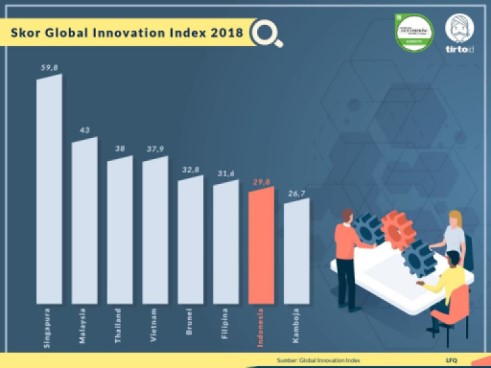
The Global Innovation Index (GII) releases an annual report aimed at capturing the multidimensional aspects of innovation by understanding in more detail the human factors behind innovation to boost economic development. This report, produced by Cornell University, INSEAD, and the World Intellectual Property Organization, uses seven calculation frameworks: institutions, human capital and research, infrastructure, market sophistication, business sophistication, scientific outputs, and creative outputs. The score range is 0-100. Also read: UI Economist Says Economic Growth Needs to Be Driven by Innovation. In the 2018 report, Singapore, with a score of 59.8, was listed as the only Asian and ASEAN country in the world's top five. Other ASEAN countries in the top 50 are Malaysia at 35th and Thailand at 44th.
Meanwhile, Indonesia ranks 85th with a score of 29.8. Within ASEAN, Indonesia ranks second from the bottom, just above Cambodia, which scored 26.7. Above Indonesia are the Philippines (31.6), Brunei (32.8), and Vietnam (37.9).
Research Is Key
The GII report states that China is one of the fastest-growing countries. In 2011, for example, China ranked 29th with a score of 46.4. Then, in 2018, China entered the world's top 20 at 17th, with a score that rose 6.7 points to 53.1. Indonesia, meanwhile, only rose 2 points over nearly a decade. China's rapid rise is driven by government policies prioritizing research and development (R&D). Indicators that recorded increases included the number of global R&D companies, scientific publications, and tertiary enrollment. Other increases were seen in R&D spending, the number of researchers, and patents. These indicators fall under the sub-pillars of tertiary education, research and development, and knowledge creation.
In China, all three sub-pillars generally showed an upward trend. The sub-pillar with the highest score was knowledge creation, with a score of 69.13 in 2018, up from 67.09 in 2014. The next sub-pillar, research and development, recorded the largest growth, with a 14.03 point increase, from 45.05 in 2014 to 59.09 in 2018. Improvement was also seen in the tertiary education sub-pillar. In contrast, Indonesia did not show significant improvement. For five years, the knowledge creation sub-pillar tended to stagnate, with scores hovering around three. In other sub-pillars, Indonesia's achievements even declined. The largest decline occurred in the tertiary education sub-pillar, from a score of 26.80 in 2011 to 21.25 in 2018. This poor record seems to reflect the government's lack of commitment to research and improving human resources through innovation. Yet, developed countries believe that research plays a role in driving economic growth. One way to achieve this is by increasing the ratio of research and development spending to Gross Domestic Product (GDP) – or Gross Expenditure on R&D (GERD). Countries with a high commitment to research, based on 2013 data, are South Korea (4.1 percent), Japan (3.5 percent), and Finland (3.3 percent). At the ASEAN level, Singapore (2.0 percent) and Malaysia (1.1 percent) have high average GERD per GDP. Meanwhile, Indonesia's GERD per GDP has not yet reached 1 percent – only 0.085 percent – and lags far behind the global GERD, which is around 2 percent.
On the other hand, the composition of research and development spending in Indonesia is still dominated by the government. In other words, encouragement is needed to increase the proportion of the private sector or businesses in research and development. Also read: The State of the Research World in Indonesia: Lack of College Graduates The low score for the tertiary education sub-pillar is evident in the small number of college graduates in Indonesia's workforce. According to BPS data, elementary school graduates dominate the Indonesian workforce. From 2014 to 2018, at least a quarter of the workforce were elementary school graduates. If Indonesia is still dominated by low-educated workers, is the workforce ready for changes and industrial dynamics? Are Indonesian workers adaptive, flexible, and innovative enough to survive in the workforce? These questions are worth noting. This is because